“As pessoas que não acreditavam muito no meu trabalho, agora acreditam e eu creio que este prémio é uma porta aberta. Significou muito para mim e estou muito motivada.”
Na semana do Dia Internacional da Juventude, 12 de Agosto, recordamos os vencedores do Prémio Jovem Inovador “A Angola que queremos até 2030”, organizado pelo MAPTSS, PNUD e UNICEF Angola, com financiamento da Embaixada Real da Noruega em Angola.
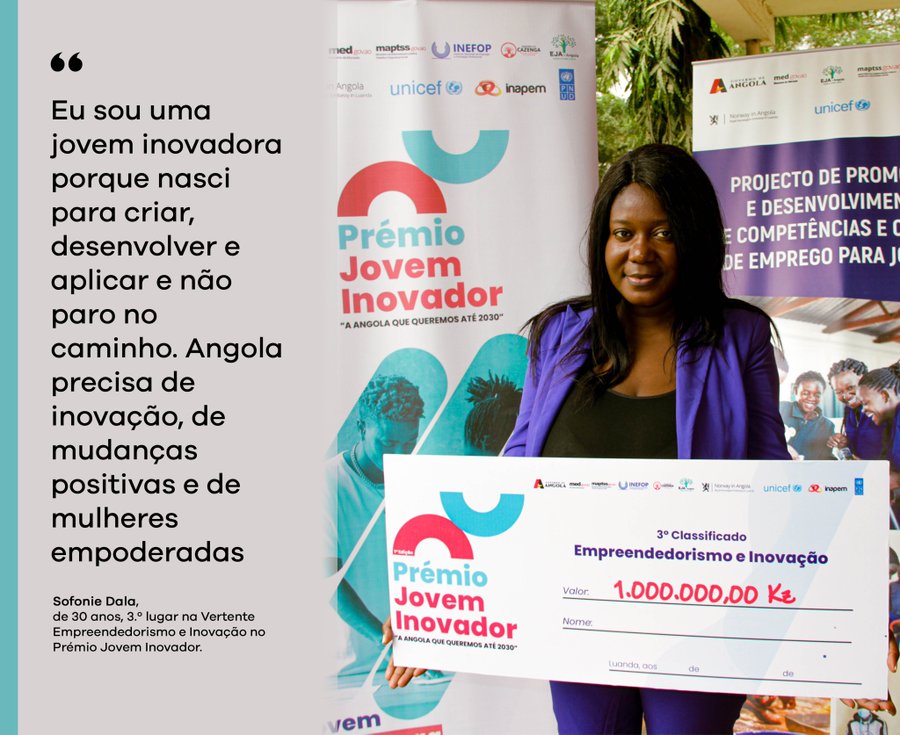
Sofonie Dala, de 30 anos, ficou em 3.º lugar no Prémio Jovem Inovador “A Angola que queremos até 2030”, com o projecto “Mulheres Sem Plástico”, uma iniciativa ambiental e de empoderamento feminino, focada na “produção de pensos reutilizáveis, para mobilizar as mulheres a deixarem de usar os pensos de plástico, que contribuem para a poluição ambiental e alterações climáticas”.
Preserving the environment is key to support sustainable economic growth as the natural environment plays an important role in supporting economic activities. Achievement of this goal can drive progress, create decent jobs for all and improve living standards.
Deservedly our founder Sofonie Dala won, and today the applause is all for her!
What we have achieved today is a small part of what we can still achieve with our talents.
When Jesus say yes, nobody can say no
The founder of the digital Startup "Talentos Multiplus" won the 1st Edition of the Young Innovator Award “The Angola we want by 2030”, in the Innovation and Entrepreneurship category promoted by the partnership developed between the Ministry of Public Administration, Labor and Social Security - #MAPTSS , through #INEFOP with technical support from UNDP, from #UNICEF with funding from the Royal Norwegian Embassy. Named "Ladies Without Plastic", the project aims to advocate for behavioural change to reduce earth vulnerability to climate change and global warming from disposable sanitary pads. Work on women liberation against harmful restrictions surrounding menstruation. It produces washable and reusable menstrual pads, which help protect the environment.
On the eve of the COP26 summit, while concluding her Anatomy of Action Challenge, Sofonie Dala launches the environmental sewing project "Ladies without plastic" at the end of 2021, with the aim of empowering and mobilizing women and girls to create their own washable and reusable pads, so they can count on good menstrual hygiene in an affordable and sustainable way, protect the environment and also generate profits for themselves and their families by selling reusable products in the Angolan market.
The party of the Young Innovator Award Competition – "The Angola we want by 2030", was held on July 7, 2022 at the Cazenga Media Library in Luanda. The event had as main objectives:
* Reward young people with innovative solutions and social impact in their communities;
* Encourage the emergence of new forms of cultural and artistic expression;
* Promote entrepreneurship and social innovation among young people in the municipality of that municipality.
This award is part of the project on the promotion and development of skills and job creation for young people in the municipality of Cazenga, as well as it aims to promote innovative actions and solutions with social impact in the municipality of Cazenga, which contribute to the achievement of the Sustainable Development Goals – SDGs.
Happiness that is sought from selfish motives, outside of the path of duty, is ill balanced, fitful, and transitory; it passes away, and the soul is filled with loneliness and sorrow; but there is joy and satisfaction in the service of God. The Christian is not left to walk in uncertain paths; he is not left to vain regrets and disappointments.If we do not have the pleasures of this life, we may still be joyful in looking to the life beyond.
This year's theme is: Making Menstruation a normal fact of life by 2030
To create awareness about menstruation, provide safe and hygienic practices to girls, and burst the bubble of taboo, World Menstrual Hygiene Day is celebrated on May 28 all over the world.
We advocate for behavioural change to reduce earth vulnerability to climate change and global warming from disposable sanitary pads. Work on women liberation against harmful restrictions surrounding menstruation.
We mobilise women to switch back to the use of reusable sanitary pads and napkins than disposable sanitary pads that have local ecosystem vulnerable to climate change and global warming.
Watch our On Demand video
Today, millions of women and girls* around the world are stigmatised, excluded and discriminated against simply because they menstruate.
We believe that girls are also powerful agents of change.We work all year round to:
- Break the taboos and end the stigma surrounding menstruation,
- Raise awareness about the challenges regarding access to menstrual products,
- Mobilise the funding required for action at scale.
According to UNFPA, May 28 signifies the menstrual cycle of females. As a fertility cycle lasts for 28 days, the date is selected to be 28. In the same way, an average period lasts for five days, which gives us the fifth month of the day, May. Therefore, to give it a meaning in itself, May 28 is celebrated to mark the change that occurs in a female body.
She Codes Africa - IBM RPA Solution to Address Climate change
Digital transformation has become the key for processes involving people and companies.
Good morning ladies and gentlemen!
My name is Sofonie Dala, I am from Angola. I'm happy to see you again in this fantastic program!
In today's program we will be building a bot with IBM RPA that makes a difference in the world and contributes to society. We will combine technology with solutions to social challenges already developed on our platform. We will be developing code to meet today's and future needs.
Artificial inteligence: Supporting and inspiring women and girls to addresstomorrow's needs and aspirations
By using opportunities offered by IBM, we will create a space that gives rural and vulnerable urban women and girls a chance to learn programming in an environment that makes them feel safe, empowered and inspired.
How does it work?
Practical exercise 1 – Starting the browser “Climax” on IBM RPA Studio
We created our own browser and named it climax- The bot opens our medium digital platform enabling women and young people to navigate the range of available positive climate action resources and not only.
As you can see a new Chrome Browser window opened and the non-profit Talentos Multiplus page also opened.
Nice! Our first run with IBM RPA. Let's keep on going!
Practical exercise 2 – Interactive chatbot
This hands-on lab we used RPA Automation Studio to create and deploy our own chatbot. This RPA interactive chatbot educates ladies and young people to reduce their carbon footprints in the environment by avoiding plastic items which cannot be reusable.
Saving the Chatbot, then successfully running the bot
Bot asking users to send their emails to receive monthly newsletter
´
At the end bot asks users to send their emails to receive newsletter and subscribe to our YouTube channel
THIS COMPLETES THIS HANDS-ON LAB
As the world continues to move dramatically towards online channels, the nature of how and why we use the internet is evoluting. That evolution will not stop, which is why it is critical for us to focus on the future and invest in what people and companies will need years from now, not simply what they are desperate for today.
Leaving No One Behind in a Digital World
"Being able to use a mobile phone and being able to access the internet requires certain skills, including literacy, as well as digital skills." And if you look at education on the continent, many women fall behind men in terms of literacy levels. Some 200 million Africans are still offline — either voluntarily or involuntarily.
Therefore, this project is for those marginalized group who lack access to digital technologies and knowledge, skills and competencies required to navigate them.
Conclusions
To conclude, the IBM RPA bots represent opportunities for positive social impact. Chatbots can make needed services more accessible, available, and affordable. They can strengthen users' autonomy, competence, and (possibly counter-intuitively) social relatedness.
The project will have a positive environmental impact because it will decrease the amount of waste dumped in rivers and on land by replacing disposable items and plastic sanitary pads with washable, reusable pads in millions homes.
We make the delivery of occupational education and skills training, employment of women and young people, special benefits for the employees. Looking at the social issues our communities currently facing, we are solving it by providing skills development for empowerment.
By empowering young ladies to learn coding, we are creating leaders who will build applications that will positively impact people's lives in Angola as well as reduce illiteracy and unemployment rates.
There’s no doubt that with this IBM RPA technology we will help end period poverty in Africa. Our work built on a culture of smart strategic thinking and creative innovation, will inspire and guide youth action for both individual and systems change that enables sustainable lifestyles.
What does IBM technology do?
Workplace Improvement Solution - Bots that automate processes within your organization
Automation for a Social Challenge: Bots that automate process for climate issues, Covid vaccinations or testing, food bank management, education, child marriage, health and human services, etc.



Na semana do Dia Internacional da Juventude, 12 de Agosto, recordamos os vencedores do Prémio Jovem Inovador “A Angola que queremos até 2030”, organizado pelo MAPTSS, PNUD e UNICEF Angola, com financiamento da Embaixada Real da Noruega em Angola.
Sofonie Dala, de 30 anos, ficou em 3.º lugar no Prémio Jovem Inovador “A Angola que queremos até 2030”, com o projecto “Mulheres Sem Plástico”, uma iniciativa ambiental e de empoderamento feminino, focada na “produção de pensos reutilizáveis, para mobilizar as mulheres a deixarem de usar os pensos de plástico, que contribuem para a poluição ambiental e alterações climáticas”.